/https://public-media.smithsonianmag.com/filer/94/6e/946e916e-37ed-44fe-8e50-86a572b3c1eb/file-20180703-116132-10gfrbg.jpg)
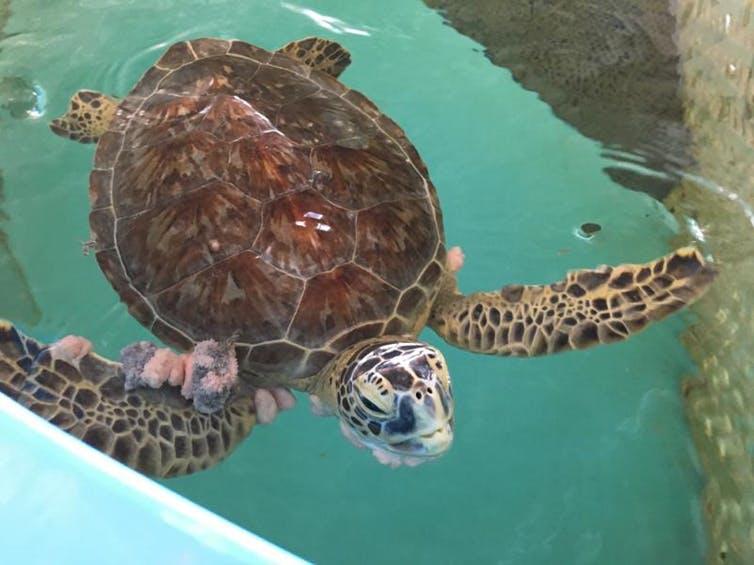
ea turtles’ reality is very different than the fun-loving, playful way they’re depicted in popular movies such as Finding Nemo. Far from being carefree, sea turtles across the globe are heavily burdened by debilitating soft-tissue tumors. All seven species of sea turtle found in the Earth’s oceans are classified as vulnerable, endangered or critically endangered– and they’re all affected by these tumors. They inhibit the animals’ vision, feeding and movement. Combined with other human-caused environmental problems, the growths threaten sea turtles’ very existence.
My colleagues and I at the University of Florida’s Whitney Laboratory and Sea Turtle Hospital are turning to recent technological advances and novel genetic and therapeutic applications to try to untangle how this disease works. Some of our best insights are coming from using the tools of human oncology and precision medicine. Hopefully we’ll ultimately halt the disease’s global takeover and help the sea turtles afflicted in the wild.
These sea turtle tumors are caused by a disease called fibropapillomatosis, first described by marine biologists in the Florida Keys in the 1930s. After decades of study, many questions remain about this contagious disease as it continues to spread.
Should We Share Human Cancer Treatments With Tumorous Turtles?
They may be key to saving wild sea turtles from tumors associated with turtle-specific herpes
image: https://thumbs-prod.si-cdn.com/72E7BuRrrTImf6GpZEbyDZAkizc=/800x600/filters:no_upscale()/https://public-media.smithsonianmag.com/filer/94/6e/946e916e-37ed-44fe-8e50-86a572b3c1eb/file-20180703-116132-10gfrbg.jpg
By
SMITHSONIAN.COM
Sea turtles’ reality is very different than the fun-loving, playful way they’re depicted in popular movies such as Finding Nemo. Far from being carefree, sea turtles across the globe are heavily burdened by debilitating soft-tissue tumors. All seven species of sea turtle found in the Earth’s oceans are classified as vulnerable, endangered or critically endangered– and they’re all affected by these tumors. They inhibit the animals’ vision, feeding and movement. Combined with other human-caused environmental problems, the growths threaten sea turtles’ very existence.
My colleagues and I at the University of Florida’s Whitney Laboratory and Sea Turtle Hospital are turning to recent technological advances and novel genetic and therapeutic applications to try to untangle how this disease works. Some of our best insights are coming from using the tools of human oncology and precision medicine. Hopefully we’ll ultimately halt the disease’s global takeover and help the sea turtles afflicted in the wild.
**********
These sea turtle tumors are caused by a disease called fibropapillomatosis, first described by marine biologists in the Florida Keys in the 1930s. After decades of study, many questions remain about this contagious disease as it continues to spread.
Researchers have identified a turtle-specific herpes virus associated with the disease. But it seems that the virus alone is not sufficient to lead to tumor formation; it needs to be triggered by a localized environmental condition. Human-related factors such as water pollution and increased UV radiation exposure because of the depleted ozone layer may exacerbate fibropapillomatosis tumor growth, similar to how sun exposure increases the risk and severity of human skin cancers.
My colleagues and I are focusing first on better understanding how these incapacitating turtle tumors grow.
Are particular body locations more susceptible to tumor development? Body parts subject to the most prolific fibropapillomatosis tumor growth include the eyes – affecting turtles’ ability to see and survive in the wild – and the soft, vulnerable underside of the shell.
How quickly do tumors grow in different body parts? We’ve found that ocular tumors regrow significantly faster than tumors located on other parts of the turtle anatomy.
How does surgical removal affect the turtle tumors? Even after multiple rounds of tumor-removal surgery using a cauterizing carbon dioxide laser, persistent tumor regrowth is a recurring problem in infected sea turtles. We’ve found that, on average, 60 percent of rehabilitating turtle tumors regrow within 36 days. On average, 60 percent of rehabilitating turtle tumors regrow within 36 days. We’d expect true regrowth rates over a prolonged period in the wild, however, to be much more severe. Underlying genetic features could be part of what drives these tumors to grow back again and again.
Now that we’ve filled in some of this baseline data, we want to target the genetic factors that are responsible for accelerating tumor growth. The goal is to optimize targeted therapeutics that can be tested for effectiveness in sea turtles that end up in our hospital.
Fibropapillomatosis threatens marine turtle health in ways very similar to how skin cancers adversely affect human health. So why not tackle these turtle tumors with the techniques and approaches of human oncology and genetic medicine?
That’s just what my colleague David Duffy is doing by applying precision medicine-based approaches that combine an individual’s specific genes, environment and lifestyle to optimize the efficacy and therapeutic benefit of their medical care. He’s profiled fibropapillomatosis tumor tissue that’s been surgically removed by laser resection as part of rehabilitation. Then it’s possible to compare the genes that are expressed in tumor tissue to those in biopsies from non-tumor areas of the same turtle. By examining the viral genes in the herpes virus as well as the turtle genes associated with tumor growth, he’s gained vital insight into the nature and triggers of the disease.
It turned out that although reptile in nature, the tumors share their underlying genomics with human cancer types – most closely resembling the human skin cancer basal cell carcinoma. Because of these similarities, specific human anti-cancer therapies should work successfully in sea turtles.
The Turtle Hospital on Marathon Key and the University of Florida’s Sea Turtle Hospital, working closely together, have used human anti-cancer drug treatments such as fluorouracil to decrease post-surgical recurrence of eye tumors in sea turtles.
This concept is not so far-fetched when you consider that most cancer drugs for dogs, for instance, were actually first developed for people. And thanks to the field of comparative oncology, the pipeline runs both ways – insights from canine cancer patients are informing human treatments.
Should We Share Human Cancer Treatments With Tumorous Turtles?
![Should We Share Human Cancer Treatments With Tumorous Turtles?]() Reviewed by Your Edu
on
July 14, 2018
Rating:
Reviewed by Your Edu
on
July 14, 2018
Rating:
No comments: